
By Jane Bloodworth Rowe
Virginia Beach, Virginia | February 5, 2026
For centuries before the English landed at Cape Henry, the Chesepians lived along the coast of what is now Virginia Beach, hunting and fishing in the rich waterways and often interacting with their friends and neighbors, the Nansemond tribe.
Their legacy, often overlooked in history books, was celebrated in a land recognition ceremony at the Virginia Beach Municipal Center on Thursday, February 5, that was attended by city dignitaries, community members, and tribal leaders from Eastern Virginia tribes.
A plaque acknowledging the Indigenous People was unveiled in the ceremony, and tribal leaders also presented gifts to city officials to acknowledge a relationship between the city and the people who lived here before the English arrived.
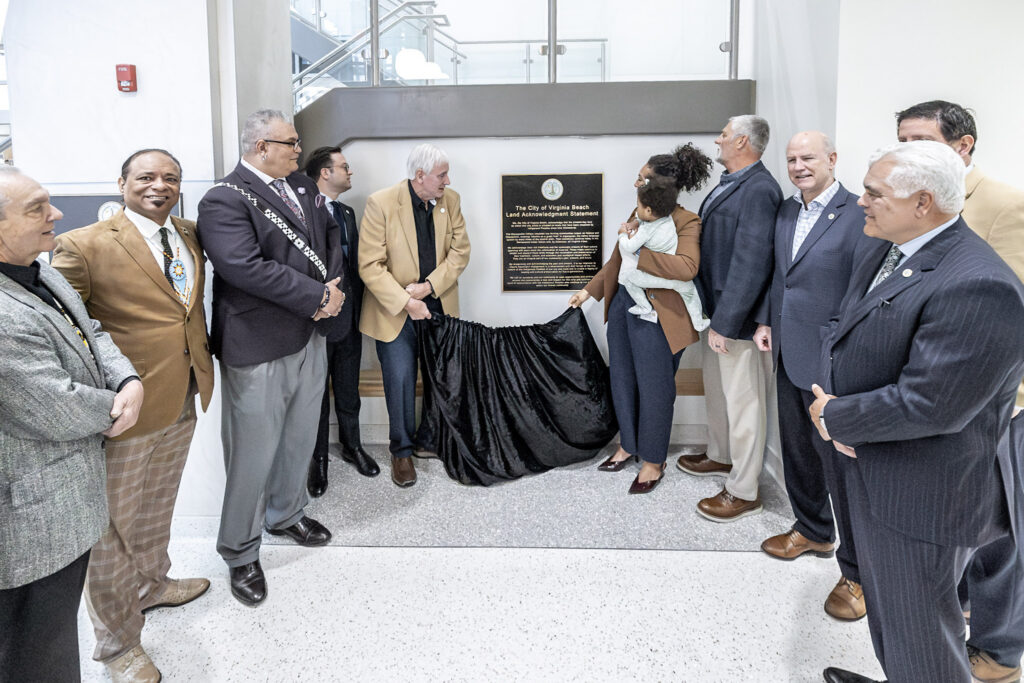
City officials, tribal representatives, and community members gather around the City of Virginia Beach Land Acknowledgment Statement during the February 5 ceremony.
A Two-Year Effort to Recognize Indigenous History
The ceremony was the culmination of a two-year-long effort by the Virginia Beach Arts and Humanities Commission to research Indigenous history that included reaching out to, and forming relationships with, tribal members.
Mayor Bobby Dyer and city council members, as well as representatives from the Arts and Cultural Affairs Department and the Arts and Humanities Commission, were present.
Tribal leaders and representatives from Virginia tribes, including the Nansemond, Nottoway, Pamunkey, Patawomeck, Rappahannock, and Upper Mattaponi, were also present.
They told a compelling story of how city residents, tribal leaders, and city officials collaborated to organize the event, which acknowledged the Indigenous people who once inhabited the land that later became Virginia Beach.
An Idea Begins to Take Shape
Michael Cloud-Butler moved to Virginia Beach when he was an adolescent and, as an adult, became active in city affairs, serving on the Resort Area Advisory Commission before being appointed to the Arts and Humanities Commission.
As an artist, Cloud-Butler found his work on the commission to be rewarding. As a Native American, he found a way to integrate his interest in the arts with a desire to tell a story that wasn’t often told.
Cloud-Butler, a member of the Anishinaabe-Ojibwe tribe of Wisconsin, began collaborating with City Council member Michael Berlucchi. Berlucchi, who formerly worked at the Chrysler Museum, had been instrumental in arranging a Land Acknowledgement ceremony at the museum, which recognized the Indigenous People of Norfolk.
Berlucchi, Cloud-Butler, and others advocated for a land recognition in Virginia Beach that would recognize the Chesepians, a group not mentioned in the Chrysler Museum acknowledgement.
In October 2023, City Council passed a resolution to form a partnership between Indigenous people and the city. In early 2024, the Arts and Humanities Cultural Equity Committee began research and discussion that would make it possible.
“It’s taken two years to come to fruition,” said Emily Labows, Cultural Affairs Director. “It’s a great day.”
“It was an idea to see what’s possible,” said Council member Jennifer Rouse. “This is a part of the community that doesn’t get a lot of recognition, and I’m happy to see it all come together.”
“Today Is About More Than a Plaque”
Dyer officiated at the ceremony and acknowledged the tribal leaders who were present, including Chief Keith Anderson of the Nansemond Indian Nation. Connor Tupponce, a member of the Upper Mattaponi Tribe, performed a song to honor the event.
“Today is about more than a plaque,” said Dyer, who praised the committee’s work and noted that it was an “honor” to be joined by tribal leaders.
Tribal leaders presented gifts, including a cedar bowl carved by Nottoway artist Nathan Elliot from cedar harvested in Mattanock, a tribal village located in Suffolk.
Tribal leaders also shared some of their legacy at the ceremony and in interviews before and after the event.
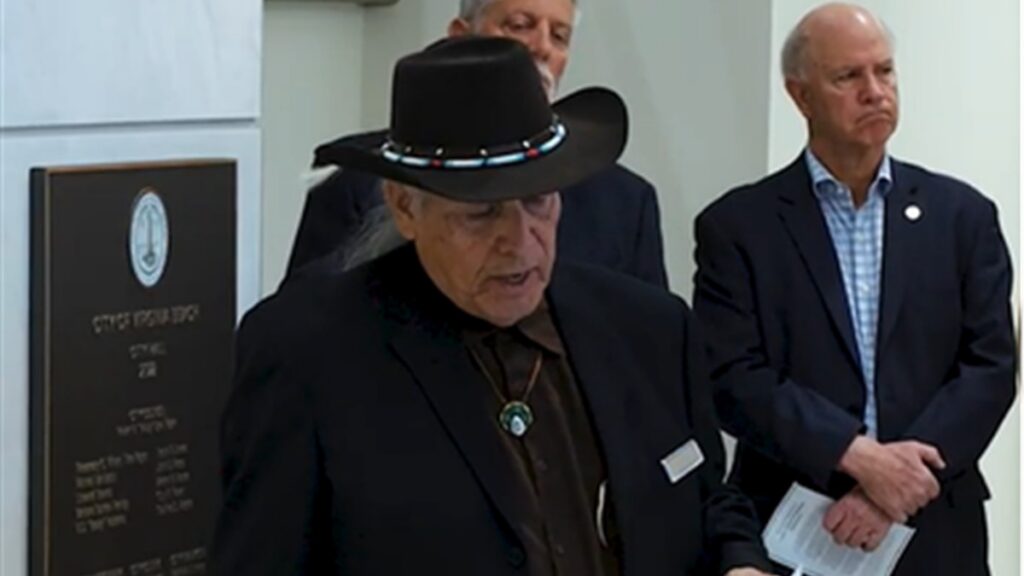
A tribal representative speaks during Virginia Beach’s Land Acknowledgement Ceremony.
Remembering the Chesepians
The Nansemond Tribe, Anderson said, had a “cultural and historical footprint in all seven cities of Hampton Roads as well as in Eastern North Carolina.”
In an interview prior to the ceremony, he noted that they were “cousin tribes to the Chesepians” and probably, like the Chesepians, hunted and fished along Back Bay.
“They were back and forth,” said Anderson, and “they may have brought the survivors back” after the destruction conducted by Powhatan around the year 1600.
Chief Powhatan’s warriors attacked the Chesepians, killed the warriors, and destroyed their villages. It’s likely that the women and children survived and became assimilated with neighboring tribes.
“From the history I’ve heard, the Chesepians were not a war-like people,” Anderson said.
He and Chiefs Emeriti Lee Lockamy and Sam Bass noted the relationship that the Chesepians had with the bountiful coastline that they inhabited.
“The Native Americans never took more from the land than they needed,” Bass said.
A History Often Left Out
“They seem to get left out of the history,” said Lockamy of the Chesepians.
He grew up in Pungo and has done considerable research on that tribe, which inhabited an area from the North Carolina line to Great Neck.
“They probably walked from Carolina through Sandbridge Beach and up to Great Neck,” Lockamy said.
They quite possibly had some contact with members of the Lost Colony, and some tribal members may have been lighter-skinned than members of other tribes.
Because some were assimilated into the Nansemond tribe, it’s likely that aspects of their culture remain, Lockamy said.
Acknowledging the Land and Its People
Council member Stacy Cummings, a member of the Lumbee Tribe, read the land acknowledgement statement, which also states that:
“the present-day land on which this city exists is situated on lands that have been inhabited by Indigenous Peoples since time immemorial.”
The plaque pays homage to the Chesepians and notes that:
“their bloodlines continue today in the Nansemond Indian Nation and, by extension, all Virginia tribes.”
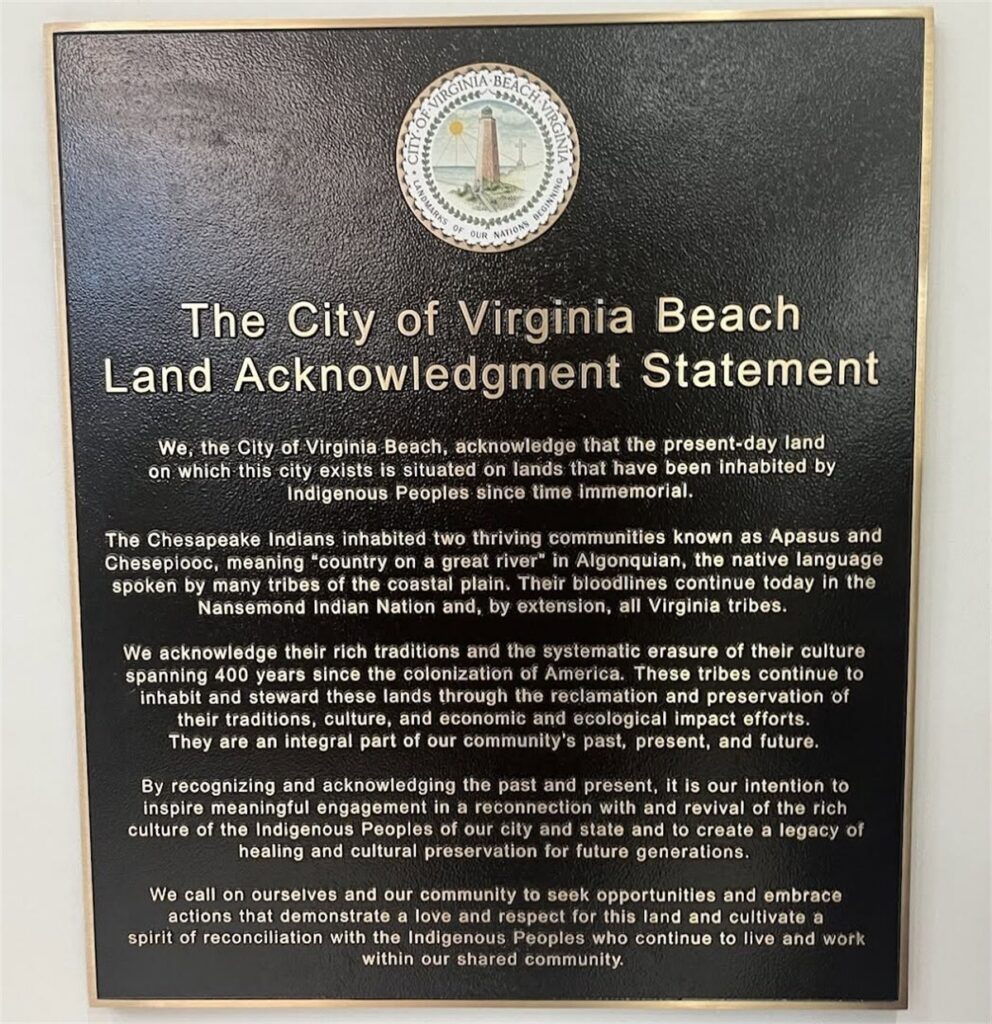
The City of Virginia Beach Land Acknowledgment Statement recognizes the Indigenous peoples who inhabited the land and the continuing legacy of the Chesepians.
Educating Future Generations
In an interview before the ceremony, Bass, who often speaks to school groups and civic clubs about the Indigenous history of Virginia, said that his goal is “to educate the children and the public about history” and correct some stereotypes about Native Americans.
“I remember that I read the word ‘savages’ in my fourth-grade history book,” he said, adding that events such as the land acknowledgement ceremony recognize the Indigenous people “to be part of history.”
“We want to make people aware that the Native people are here to stay.”
Reporting by Jane Bloodworth Rowe for Neely Media
Neely Media | Community Stories. Local Impact. Regional Voices.


